Everbuild Silicone 825 is still sold, under a new name: the same cartridge is now sold as Sikasil 825 Silicone 380ml, and its product page opens with the line “Formerly sold as Everbuild Tecnic Silicone 825”. If you have been pointing frames or sealing glazing with the Everbuild cartridge, this is the product you order now. Below you will find what the product page says it is, where it is used, how Sika says the surface is prepared, and when one of the other Sika sealants on the site suits the joint better.

Everbuild Silicone 825 Is Now Sikasil 825: What the Product Is
The Tecnic Silicone 825 cartridge now carries the Sikasil name. Nothing about the way you order it changes except the name on the label: the site lists it as Sikasil 825 Silicone 380ml, and searches for Everbuild 825, Silicone 825 and Everbuild 825 LM all land on that one product page.
The page describes the product as a low modulus, neutral cure, low odour silicone sealant that adheres to a wide range of both porous and non porous surfaces without the need for priming. If you want the difference between a neutral cure and an acetoxy silicone explained, the bathroom sealant guide covers it; for the joints in this article the point is that Sika classes 825 as the neutral cure type.
It comes in a 380 ml cartridge, so check that your gun takes that size before you buy a box. The page also describes a high viscosity non slump formula.
Colours
Many of the searches that reach the page ask for the Everbuild silicone 825 colour chart. The product page lists the range as White, Black, Mid Grey, Dark Grey, Brick Red, Brown, Buff, Beige, Anthracite, Dark Anthracite RAL 7016, Magnolia, Portland Stone and Limestone White. That spread includes masonry and stone shades as well as whites and greys.
One thing you will not find here is a set of performance figures. The Sikasil 825 data sheet is not among the manufacturer sheets this site has verified, so this guide repeats only what the product page states and leaves the test values, movement figures and standards to the data sheet itself. Download it from Sika before you specify the product on a job that depends on them.
Where Sikasil 825 Is Used: Frames, Glazing, Metals and Masonry
The product page gives a long list of uses. Grouped by the job you are likely to be doing, they fall into four areas.
Window and door perimeters
The first use the page names is perimeter pointing internally and externally around PVCu, wood and powder coated aluminium. That is the bead between the frame and the brickwork, render or plaster reveal, inside and out. The page also lists sealing and bonding onto PVCu, plastic trims and components, so the same cartridge does the trim and cover strips around the frame.
Glazing and curtain walling
For glazing work the page lists weather sealing and joint sealing to pre-formed panels and curtain walling, glazing sealing and draught proofing, glass to glass and glass to aluminium sealing, and the bedding and sealing of insulated glass units. If you are putting a facade package together, the curtain walling and glazing products category holds the related Sika sealants and tapes.
Soft metals, parapets and masonry
The page names sealing soft metals such as lead, copper and zinc, and parapet and roof weather sealing applications. It also lists precast concrete and masonry products, including brick, natural stone and terracotta. The page adds that the product is suitable as an expansion joint sealant; joint sizing, backer rods and the sealant used for trafficked floor joints are covered in the expansion joint sealant guide, so this article does not repeat them.
Two cautions. The list above is the product page’s list, and it does not include sanitary, kitchen, aquarium or vehicle work, so do not read those uses into it. And check the Sika data sheet for any substrates or conditions the product is not meant for before you use the sealant on anything unusual; the product page does not cover them and neither does this guide.
Preparing the Surface: Sika Cleaner P and Sika Aktivator 205
The product page states that Sikasil 825 does not require a primer on most common surfaces, although adhesion tests are recommended prior to full scale application. Take that second half seriously and test on an offcut of the actual frame, panel or stone before the job. The page names a Sika primer for two cases, a joint that is likely to be immersed and a surface where adhesion is poor, especially a porous one; that primer is not sold on this site, so check the product page for the name if either case applies to you.
The general rule on the page is that surfaces must be clean, dry and free from dust, grease and other contaminants, with dust removed by compressed air and grease taken off with a solvent soaked pad followed by a wipe with a clean cloth. The page then gives a short preparation list by substrate:
- Glass, aluminium, light alloys and stainless steel: degrease.
- Other metals: lightly abrade, then degrease.
- Wood: lightly abrade the surface, then remove the dust.
- Plastics: degrease with an agent recommended by the plastics manufacturer.
- Concrete and other alkaline surfaces: brush and remove the dust.
- Polyester powder coated aluminium (PPCA): Sika Cleaner P, then Sika Aktivator 205.
For cleaning up, the page gives white spirit for uncured sealant and mechanical removal once it has cured, so wipe tools and the gun nozzle before the skin forms.
Sika Cleaner P
Sika Cleaner P is the cleaner the Sikasil 825 page names for powder coated aluminium. Its own page describes it as a solvent-based colourless clear cleaning agent for non-porous substrates, used to remove foreign matter and contaminants such as grease, oil, dust and dirt before sealants and adhesives go on. It must only be used on non-porous substrates, so it is for the glass, metal and plastic side of the joint and never for the brick or render side. The method on its page: wet the paper towel by pouring Sika Cleaner P onto it, never dip the towel into the cleaner, wipe the surface, and wipe the solvent off with a clean dry towel before it evaporates. Sika marks the product as suitable for experienced professional users only.
Sika Aktivator 205
Sika Aktivator 205 is the second product the 825 page names, for improving adhesion, if required, to non-porous surfaces. Its own page describes it as a solvent-based colourless clear adhesion promoter used on non-porous substrates such as metals, plastics, ceramic screen prints and painted surfaces, wiped on sparingly with a clean, lint-free towel moistened, not wet, with the activator. The page carries the same two warnings as the cleaner: the product is for experienced professional users, and tests with the actual substrates and conditions have to be performed. On a powder coated frame the order is cleaner first, activator second, then the sealant.
Sikasil 825, Sikasil WS-605 S or Sikaflex AT Connection: Which Sika Sealant for the Joint
The site sells three Sika products that all meet a window or facade joint at some point, and the product pages draw the lines between them.
Sikasil 825 Silicone 380ml is the one for the uses in the previous section: perimeter pointing around frames, glazing and curtain walling joints, soft metal flashings and masonry or precast joints, in the colour range above.
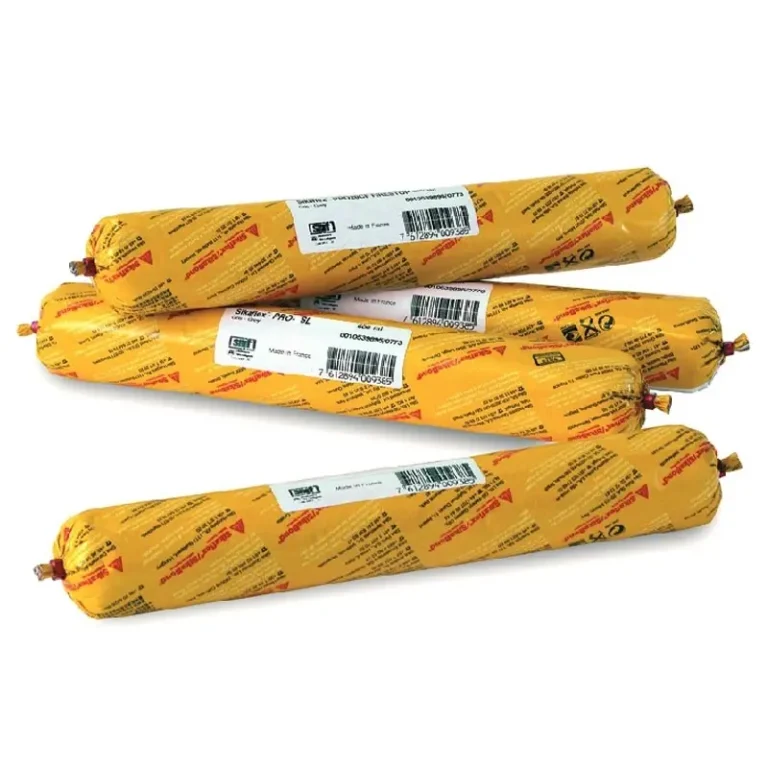
Sikasil WS-605 S 600ml is described on its page as a neutral-curing silicone sealant for weatherproofing and sealing applications where durability under severe conditions is required, and as particularly suited as a weather seal for structural glazing, curtain walling and windows. It comes as a 600 ml unipack rather than a cartridge, and Sika marks it as suitable for experienced professional users only.
Sikaflex AT Connection 600ml is a different chemistry: a silane terminated polymer sealant, which Sika lists for connection joints between porous and non-porous substrates, such as windows and doors and other building parts (Sikaflex AT Connection PDS v02.01). Where the two silicones give you no verified figures here, the Sikaflex AT Connection data sheet does: a skin time of approximately 60 minutes at 23 °C and 50 % relative humidity, a curing rate of approximately 2 mm per 24 hours under the same conditions, movement capability of plus or minus 25 % to ISO 9047, an application temperature of +5 °C to +40 °C for air and substrate with the substrate at least 3 °C above the dew point, and a service temperature of -40 °C to +90 °C (all Sikaflex AT Connection PDS v02.01). How to prepare and fill that joint is covered in Sikaflex AT Connection: What It Does and How to Use It.
So the choice runs on the joint, as the pages state it. A frame perimeter, glazing bead, lead flashing or stone joint that needs a colour match takes Sikasil 825. A structural glazing or curtain walling weather seal specified for severe exposure takes Sikasil WS-605 S. A connection joint between a frame and a porous wall where you want a published movement figure takes Sikaflex AT Connection. If the question is wider than these three, polyurethane against hybrid against silicone, Construction Sealant: Types and How to Choose walks through the sealant types.
Before you order
- Order Sikasil 825 Silicone 380ml, the current name for Everbuild Silicone 825, and pick the colour from the page’s list of 13.
- Check that your gun takes a 380 ml cartridge.
- Match the use to the page’s list: frame perimeters, glazing and curtain walling, soft metals and parapets, masonry and precast.
- Prepare the substrate as the page lists it, and add Sika Cleaner P and Sika Aktivator 205 for powder coated aluminium.
- Run an adhesion test on the real substrate before the full job.
- Download the Sika data sheet for the figures and limitations this guide does not state.
- Browse the rest of the range in adhesives and sealants.