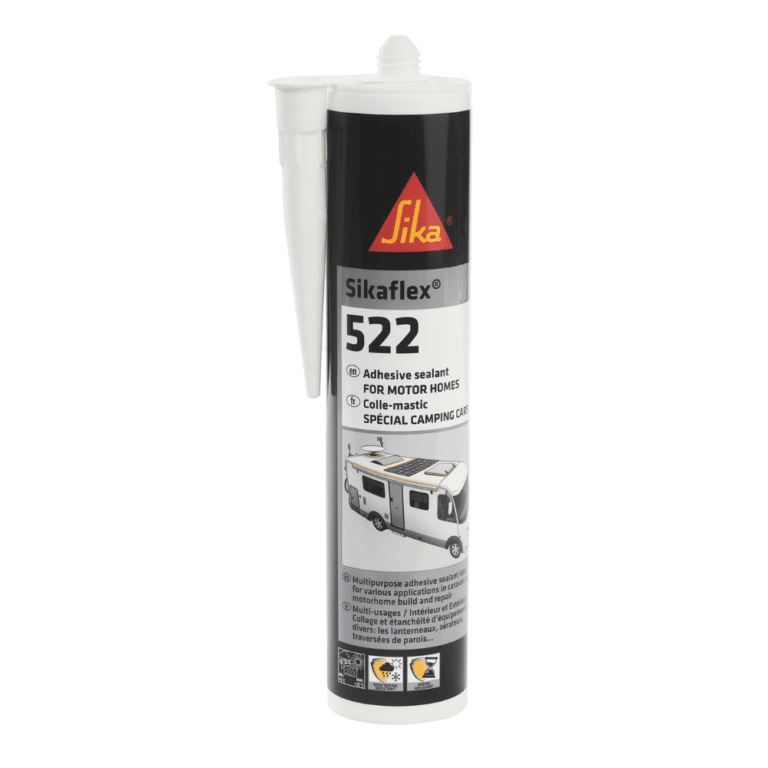
When working on sealing and bonding projects, choosing the right adhesive or sealant can make a significant difference in durability and performance. Sikaflex 522 and Sikaflex 221 are two popular products from Sika, but they serve slightly different purposes. If you already know you need the polyurethane product, the Sikaflex 221 300ml product page lists the pack sizes and colours. Understanding their differences can help you pick the right one for your application.
1. Understanding the Basics
What is Sikaflex 522?
Sikaflex 522 is a low-emission, 1-component silane terminated polymer (STP) sealant and adhesive (Sikaflex-522 PDS v07.01, 10-2025). The data sheet describes high weathering and mould resistance and good adhesion to a wide variety of substrates, and lists it for interior and exterior elastic sealing and bonding, which is why it is the usual choice on caravans and motorhomes.
What is Sikaflex 221?
Sikaflex 221 is a multi-purpose, 1-component polyurethane adhesive and sealant (Sikaflex-221 PDS v05.01, 03-2026). The data sheet says it bonds well to a wide variety of substrates such as metals, metal primers and paint coatings (2-component systems), ceramic materials and plastics, and that it is suitable for making permanent elastic seals, which is why it is common in vehicle building, construction and industrial work.
2. Key Differences Between Sikaflex 522 and Sikaflex 221
| Feature | Sikaflex 522 | Sikaflex 221 |
|---|---|---|
| Chemical base | Silane terminated polymer (STP) | 1-component polyurethane |
| Cure mechanism | Moisture-curing | Moisture-curing |
| Skin time (23 °C / 50 % r.h.) | 30 minutes | 60 minutes |
| Application temperature | 5 °C to 40 °C | 5 °C to 40 °C |
| Service temperature (long-term) | -50 °C to 90 °C | -50 °C to 90 °C |
| Shelf life (stored below 25 °C) | 12 months (cartridge) | 12 months |
| Colours | White, grey, black | White, grey, black, brown |
| Weathering | High weathering and mould resistance (data sheet description) | Not stated in the data sheet summary |
| Emissions | Low-emission (data sheet description) | Not stated in the data sheet summary |
Source: Sikaflex-522 PDS v07.01 (10-2025) and Sikaflex-221 PDS v05.01 (03-2026). Full cure time and primer requirements are not given as figures in either data sheet; check the current Sika data sheet and primer chart for your substrate. For working times across the range, see How Long Does Sikaflex Take to Dry?
3. Application Areas
Typical uses for Sikaflex 522
- Caravans and Motorhomes: Ideal for sealing joints in campervans and motorhomes because of its weathering and mould resistance (PDS v07.01).
- Exterior joints on vehicle bodywork: the data sheet lists interior and exterior elastic sealing and bonding (PDS v07.01).
- Roofing and Construction: Used for sealing joints exposed to weather.
- Low-emission requirement: the data sheet describes Sikaflex 522 as a low-emission sealant and adhesive (PDS v07.01).
Typical uses for Sikaflex 221
- Automotive and Transportation: Excellent for sealing and bonding in vehicles, including trucks, trailers, and buses.
- Heavy-Duty Industrial Applications: Used in manufacturing, construction, and metal fabrication.
- Bonding: the data sheet lists metals, metal primers and paint coatings (2-component systems), ceramic materials and plastics (PDS v05.01).
- General-Purpose Sealing: Suitable for applications requiring strong adhesion and flexibility.
For a longer list of jobs, see What Is Sikaflex 221 Used For? 10 Real-World Applications.
4. Pros and Cons
Sikaflex 522
✅ Pros:
- Low-emission (PDS v07.01)
- High weathering and mould resistance (PDS v07.01)
- Highly flexible and elastic
❌ Cons:
- Not as strong in high-load structural bonding
Sikaflex 221
✅ Pros:
- Strong adhesion and durability
- Great for industrial and automotive applications
- Good flexibility
❌ Cons:
- Polyurethane base: 60-minute skin time against 30 minutes for Sikaflex 522 (PDS v05.01 and v07.01)
5. Which One Should You Choose?
Your choice depends on the specific needs of your project:
- If you need a low-emission sealant-adhesive with high weathering and mould resistance for exterior joints, go for Sikaflex 522 (PDS v07.01).
- If you require strong bonding for industrial, automotive, or heavy-duty applications, Sikaflex 221 is a better fit.
For general sealing and bonding on a caravan or motorhome exterior, Sikaflex 522 is the usual choice because of its weathering and mould resistance. However, if your project demands high-strength adhesion in industrial settings, Sikaflex 221 will perform better.
Two related comparisons: Sikaflex 252 vs 522: Which Caravan Sealant? and Sikaflex 522 vs 521 UV: What’s the Difference for Outdoor Use? The full caravan sealants range is in the Caravan Sealants category.
Final Thoughts
Both Sikaflex 522 and Sikaflex 221 are 1-component, moisture-curing sealant-adhesives with the same application temperature range (5 °C to 40 °C) and the same long-term service temperature range (-50 °C to 90 °C) (PDS v07.01 and v05.01); the chemistry, skin time and colour range differ. Understanding your project’s requirements will help you choose, ensuring durability, strength, and longevity in your sealing or bonding work. If you need low emissions and UV resistance, choose Sikaflex 522. For heavy-duty bonding in automotive or construction applications, go with Sikaflex 221.
Do you have experience using Sikaflex products? Let us know your thoughts and which one you used!
For more technical details, check out the official datasheets:
- Sikaflex 522: Technical Datasheet
- Sikaflex 221: Technical Datasheet