What passive fire protection is and why it is a distinct product category
Passive fire protection limits fire and smoke spread through fixed building elements. It does not require people to operate it or systems to activate it. Instead, it works as part of the building’s construction, helping maintain compartmentation and protect escape routes.
Passive fire protection sealants form one product category within this wider field. You apply them to joints, gaps, and service penetrations where pipes, cables, ducts, or other building components pass through fire-resisting walls and floors.
These sealants must do more than fill a gap. During a fire, they may need to:
- maintain the required fire-resistance period;
- prevent the passage of flames and hot gases;
- accommodate movement in the joint or surrounding materials;
- limit smoke transfer; and
- remain compatible with the tested construction.
You must select a sealant according to the complete tested or assessed system, not only its stated temperature resistance or generic fire rating. Performance can depend on the substrate, joint width, backing material, penetration type, installation depth, and fixing method.
This makes passive fire protection sealant distinct from ordinary construction or acoustic sealant. Its suitability depends on documented fire-performance evidence and correct installation within a specific building assembly.
Fire sealant, fire putty and fire wrap: how they differ
Fire sealant, fire putty and fire wrap provide passive fire protection, but you use them for different joint and penetration details. Select the product according to the tested system, substrate, service type and required fire rating.
| Product type | Example | Typical use |
|---|---|---|
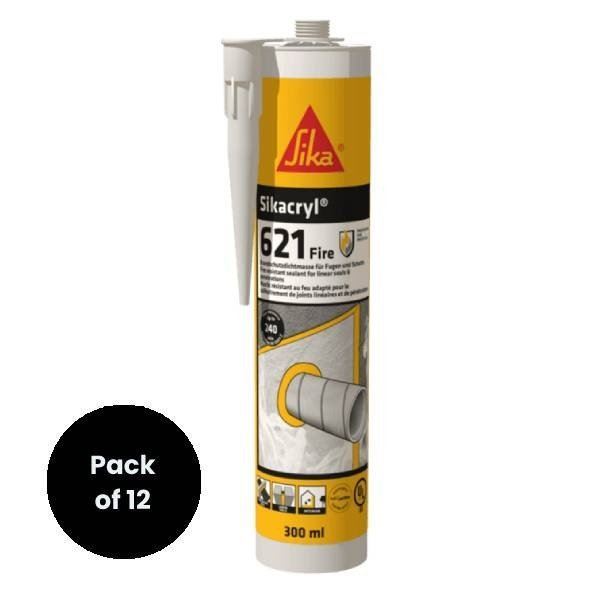
| Fire sealant | Sikacryl® 621 | Sealing interior linear joints and service penetrations in fire-resisting walls and floors |
| Fire putty | SikaSeal® 632 | Hand-sealing small openings around cables and metal pipes where a sealant cannot be applied to the required depth |
| Fire wrap | SikaSeal® 629 | Wrapping combustible pipes, such as plastic pipes, where they pass through fire-resisting walls and floors |
You apply Sikacryl 621, an acrylic fire-resistant sealant, as a bead within a prepared joint or opening. Follow the joint width, backing material and installation depth given in the tested system details.
SikaSeal 632 fire putty is a hand-workable, silicone-based putty for small openings around cables and insulated or uninsulated metal pipes, where a sealant cannot be applied to the required depth.
SikaSeal 629 fire wrap does not fill a gap like sealant or putty. You install it around a combustible pipe, usually within or against the supporting construction, and secure it according to the manufacturer’s tested detail. Sika’s data sheet for SikaSeal 629 names Sikacryl 621 among the products it can be combined with.
Always match the product and installation method to the relevant classification report or technical assessment. Do not substitute one product type for another without confirming that the complete fire-stopping system remains tested and suitable.
Which product fits which application
Choose the sealant or system according to the penetration type, substrate, movement and required fire rating. Check the tested installation details and match them to your wall or floor construction before application.
| Application | Suitable product or system | Key consideration |
|---|---|---|
| Pipe and cable penetrations | Intumescent sealant, firestop collars, wraps, sleeves or coated systems | Use a system tested for the specific pipe, cable bundle, insulation and wall or floor type. |
| Floor joints | Flexible fire-resistant joint sealant, fire-rated backing material or a tested joint system | Select a product that accommodates the joint’s expected movement and depth. |
| Wall or partition junctions | Flexible acoustic and fire-rated sealant, mineral wool backing or a tested linear joint system | Confirm compatibility with plasterboard, masonry, concrete and any movement between adjoining elements. |
For plastic pipes, use an intumescent collar or wrap where the tested system requires it, rather than relying on sealant alone.
For metal pipes and cable penetrations, choose a sealant or composite system rated for the relevant services. You may also need mineral wool backing, pipe insulation treatment or a penetration sleeve to meet the tested configuration.
At floor joints and wall junctions, use a flexible product where building movement could occur. Follow the specified joint width, sealant depth, backing material and curing requirements; changing these details can affect the system’s fire performance.
What to check for UK Building Regulations compliance
You should confirm that the passive fire protection sealant suits the specific fire-stopping application, such as service penetrations, linear joints, or perimeter gaps. Check the relevant project specification, drawings, and fire strategy before selecting a product.
Review the manufacturer’s technical data sheet (TDS) and certification. These documents should identify:
- Approved substrates and service types
- Permitted joint or opening dimensions
- Required backing materials and installation methods
- Compatibility with cables, pipes, insulation, and other components
- Tested or assessed applications
- Conditions for use, including movement, moisture, and environmental limits
You should also check that the product has suitable third-party certification or supporting assessment documentation for the intended application. Confirm that the certification covers the complete installation, not only the sealant itself.
Building Regulations requirements vary by project and location within the UK. Refer to the applicable guidance, such as Approved Document B in England, and follow any requirements set by building control, the project designer, or the fire engineer.
Keep installation records, including product batch details, locations, photographs, and installer information. Use the manufacturer’s installation instructions, and do not substitute components or change the tested configuration without documented approval.
Application and surface preparation
Before applying passive fire protection sealant, inspect the joint, penetration, or opening against the tested system details. Confirm the required sealant type, backing material, depth, substrate, movement capability, and fire-rating classification.
Prepare the surfaces so they are sound, clean, dry, and free from contaminants. Remove dust, loose particles, grease, oil, old sealant, and other materials that could reduce adhesion. Use mechanical cleaning methods that suit the substrate, and allow damp surfaces to dry unless the product instructions permit application to them.
Install backing materials, such as mineral wool or a specified backer rod, at the required depth and compression. Keep the sealant within the approved system dimensions and avoid compressing or damaging services passing through the opening.
Apply the sealant continuously, using a suitable applicator. Tool the surface to remove voids and achieve full contact with the surrounding substrate and backing material. Do not dilute the product or mix it with other materials unless the manufacturer’s instructions specifically allow it.
| Check | Requirement |
|---|---|
| Substrate | Compatible, stable, clean, and dry |
| Joint or opening | Correct size and configuration |
| Backing material | Approved type, depth, and compression |
| Sealant | Correct product, batch, and application limits |
Protect the installation from disturbance, water, dust, and temperature conditions outside the product’s stated limits during curing.
When you need specialist or engineer sign-off
You should obtain specialist or fire engineer sign-off when a passive fire protection sealant forms part of a fire-resisting wall, floor, ceiling, or service penetration and the work affects the building’s fire strategy. This is particularly important where the construction, services, or sealant system differs from the tested arrangement.
You may also need approval when:
- The penetration includes several service types or complex cable configurations.
- The substrate, opening size, or seal depth falls outside the product’s tested scope.
- The installation supports compartmentation in high-risk or high-occupancy areas.
- The project requires compliance with specific building regulations, standards, or third-party certification.
- You cannot confirm the product’s classification, compatibility, or installation limits.
A competent installer can complete straightforward work when the product has suitable third-party certification and the installation matches the approved details.
Request written advice before installation if the proposed detail does not appear in the certification or assessment. Do not rely on a generic sealant specification where the fire performance depends on the complete tested system, including the substrate, backing material, service type, and installation method.
FAQ
What is passive fire protection sealant?
Passive fire protection sealant is a fire-resistant material used to seal joints, gaps and service penetrations in fire-rated walls, floors and ceilings. It helps limit the movement of fire, smoke and hot gases between compartments.
How do you choose the right sealant?
Check the manufacturer’s tested installation details, including the substrate, joint width, penetration type, backing material and required fire-resistance period. You should also confirm compatibility with adjacent materials.
Does fire-resistant sealant replace other fire-stopping products?
No. Sealant forms one part of a complete fire-stopping system. You may also need collars, wraps, boards, mortar or other components, depending on the penetration and tested design.
How do you maintain it?
Inspect the sealant during building maintenance and after alterations. Repair damage, gaps or unauthorised penetrations using a compatible, tested system.