Concrete can let moisture pass through pores, cracks and joints, leading to damp surfaces, staining and damage over time. You can waterproof concrete by choosing a protection system that suits the source of moisture, the structure and the surface condition.
Start by identifying how water reaches the concrete and what the surface needs to withstand. The right product and careful installation help protect your work and support long-term performance.
These products go onto the hardened concrete surface of foundations, basement walls, retaining walls, water tanks and underground structures; none of them is an admixture added to the concrete mix. Waterproofing a roof with a brush-on or spray-on coating is a different job: see liquid roof waterproofing.
What Concrete Waterproofing Is and Where Water Gets In
Concrete absorbs moisture through its pore network, cracks and poorly sealed joints. As water moves through the material, it can cause damp patches, surface deterioration and corrosion of embedded steel.
Porosity, Cracks, and Water Pressure
Concrete contains connected pores that allow water to move through it. Poor compaction, an unsuitable mix or inadequate curing can increase permeability. Cracks create more direct paths, while joints and gaps around service penetrations can let water bypass otherwise sound concrete.
Water pressure adds to the risk below ground or where water collects against a structure. It can drive moisture through pores and small defects, carrying dissolved salts that may crystallise as the concrete dries. The S4Proof product pages describe this as positive and negative hydrostatic pressure. Positive directional water pressure is water pushing against the side the product is applied to, such as the outside of a basement wall or the inside of a tank. Negative directional water pressure is water coming through from the other side, such as the inside face of a basement wall that cannot be dug out. Which side you can reach, and which way the water pushes, is the first thing that decides the product.
Signs of Water Intrusion
Look for damp patches, darkened concrete, salt deposits, blistering coatings and peeling paint. White, powdery deposits often indicate that water has carried soluble salts to the surface and evaporated. A musty smell or persistent dampness on the inside of a basement wall can also point to moisture passing through the structure.
Map the affected area and check whether it changes after rainfall, plumbing use or groundwater levels rise. Record the location and size of cracks, and note any water staining around joints or pipe entries. These details help you distinguish a local leak from wider moisture movement and choose a suitable repair approach. Surface symptoms can point to a problem, while the source may sit behind the visible area.
Crystalline Waterproofing: How S4Proof CC 70 Works and Where It Goes
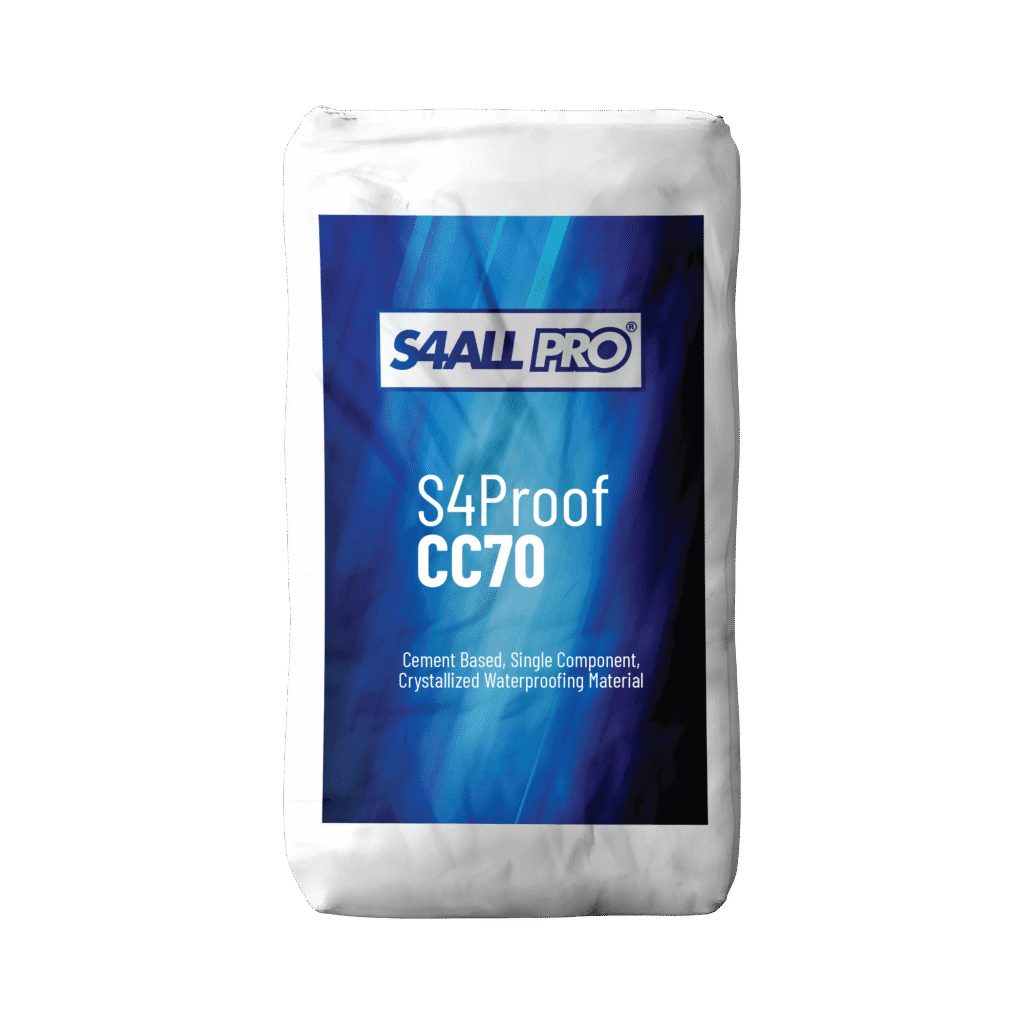
S4Proof CC 70 crystallized waterproofing material is a cement-based, single-component product that works through crystallisation. Its product page describes it as penetrating into the concrete and forming insoluble minerals in capillary spaces, which blocks the water pathways described above, so the concrete itself becomes the barrier rather than a layer sitting on top of it.
The page says it is designed for both positive and negative hydrostatic pressure applications and can be used on both new and old concrete surfaces, which makes it the option where only the inside face of a wall can be reached. Its application areas are foundations, retaining walls and basement walls; water tanks, swimming pools, underground garages and tunnels; and dams, concrete pipes, irrigation canals and culverts. It is not suitable for use on surfaces such as wood, metal, fibreboard or plaster.
The powder is mixed with water and applied with a brush or trowel in more than one coat, each layer applied perpendicular to the previous layer. The number of coats, the thickness, the mixing quantities and the time between coats come from the product data sheet and are not given here. Clean tools immediately after use with clean water.
Cement-Acrylic and Bitumen-Rubber Coatings: S4Proof CA 60 and S4Proof BT 40
Where you want a flexible membrane over the concrete rather than a treatment inside it, the site has two further options. S4Proof CA 60 cement and acrylic based waterproofing material is a two-component product: its page describes mixing component B (liquid) with component A (powder) and applying it in more than one coat with a brush, roller brush or trowel, each layer perpendicular to the previous one, with a waterproofing mesh between coats on large surface areas. The page says it forms a seamless, jointless membrane, is flexible, is resistant to both positive and negative water pressure, and is water vapour permeable, allowing the concrete to breathe.
Its application areas are foundations, retaining walls and basements; under ceramic applications for terraces, balconies and water tanks; waterproofing under tiles in bathrooms, kitchens and other wet areas; and the protection of exposed concrete surfaces. So it is the option where tiles go on top, or where a flexible membrane is wanted over concrete that may move or crack slightly.
S4Proof BT 40 modified bitumen-rubber based liquid waterproofing material is a waterborne, single-component coating with crack bridging features. Its page lists it for foundations, retaining walls, terraces and balconies, against ground dampness, leaking water and unpressurised groundwater in foundations, and for the external waterproofing of water tanks. It is resistant to positive directional water pressure, can be applied on dry and damp surfaces, adheres well to concrete, plaster and other mineral-based surfaces, does not sag on vertical surfaces, and is applied with a roller, brush or airless spray machine. Use it on the outside of foundations and retaining walls where the surface may be damp at application; the page says that in foundation curtain wall applications you should avoid soil filling without protection after the application.
Matching Systems to Exposure and Location
For below-ground walls or concrete exposed to persistent damp, assess the direction and pressure of water, drainage conditions and access to the surface. A system intended for positive-side application may need different detailing from one applied to the inside face. Confirm the specified system can handle the actual exposure and that you can protect it during backfilling or follow-on work.
For terraces and balconies, consider the finish that will sit above the waterproofing: the S4Proof CA 60 page lists use under ceramic applications, and the S4Proof BT 40 page lists use as an under coating in terrace waterproofing applications. For internal floors and tanks, check compatibility with the intended covering or stored contents. Map cracks, joints, corners and service penetrations before work starts, then use compatible components across the whole detail. Follow the manufacturer’s technical instructions and consult a building professional where water pressure or structural defects are involved.
Stopping Active Leaks and Preparing the Concrete: S4Proof RP 71 and Surface Preparation
A coating cannot be applied over water that is actively coming through. S4Proof RP 71 water plugging mortar is a cement-based, single-component, ultra-rapid setting mortar for sealing active water leaks; its page says it sets on contact with water. Its page lists it for foundations, basements, retaining walls, concrete pipes, lift shafts and water tanks, and for sealing cracks in wet or submerged concrete surfaces. It is not for use on movable cracks or general crack repair, and not for plaster, wood, fibreboard or metal.
The page describes the method: wear gloves, take a small amount of the powder in the palm of your hand, apply it directly to the water leak by pressing it in one motion, and continue pressing until it sets. After hardening, use a wire brush to level the surface. The plug stops the leak; the waterproofing coat (S4Proof CC 70, S4Proof CA 60 or S4Proof BT 40) then goes over the whole surface.
Surface Preparation and Crack Repair
Remove laitance, dust, oil, loose material, and previous coatings that could prevent the waterproofing from bonding. Use a suitable mechanical method where needed, then clear away debris and check that the surface is sound. Follow the chosen product’s instructions for moisture condition and preparation. The S4Proof CC 70 and S4Proof CA 60 pages put it the same way: the surface must be clean, smooth and solid, and free from dust, oil, grease and other contaminants.
Identify cracks before coating. Repair stable cracks with a compatible repair material, and investigate cracks that are widening or recurring because movement may require a different detail. For active water ingress, plug the leak first with S4Proof RP 71 water plugging mortar, as described above. Treat honeycombing and voids as defects to repair, since a coating cannot compensate for weak or missing concrete.
Application Conditions and Curing
Check the product data sheet and site conditions before application. Rain, condensation, strong sun, wind, or a damp substrate can affect handling and performance, depending on the product. Do not rely on a generic temperature or curing timetable. Follow the manufacturer’s stated limits, mixing instructions, coat thickness, coverage, and recoat guidance. The S4Proof CC 70 page says to avoid applying during rainy or windy weather conditions, or in areas at risk of freezing, and the S4Proof BT 40 page says to protect the applied surface from rain, snow or water until it is completely dry.
Apply consistently, paying close attention to corners and penetrations. Protect the work during curing, and do not cover it or expose it to water until the product instructions allow.
In Short
Concrete waterproofing means a cement-based or bitumen-based product applied to hardened concrete, chosen by which side of the structure you can reach and which way the water pushes. S4Proof CC 70 crystallized waterproofing material makes the concrete itself the barrier and is designed for positive and negative hydrostatic pressure; S4Proof CA 60 cement and acrylic based waterproofing material gives a flexible membrane that tiles can go over; S4Proof BT 40 modified bitumen-rubber based liquid waterproofing material coats the outside of foundations and retaining walls, on dry or damp surfaces; S4Proof RP 71 water plugging mortar stops an active leak first. Prepare the concrete, take every figure from the product data sheet, and see the waterproofing materials range at Sealants4All.